


BOSS Spreader Equipment: Which BOSS Granular Ice Control Equipment Is Right for You?
Choosing the right salt spreader starts with three questions: What vehicle are you using? What material do you need to spread? And how much material do you need to carry?
BOSS offers spreaders for a wide range of snow and ice management applications, from compact equipment and small commercial properties to large commercial and municipal operations. The right spreader can help your crew apply material more consistently, reduce unnecessary reloads, and make your equipment more productive.
Use the BOSS Product Selector to match equipment to your specific vehicle, and use the BOSS Spreader Material Guide to confirm which materials are compatible with different spreader models.
Quick Answer: How Do I Choose the Right BOSS Spreader?
The best BOSS spreader depends primarily on your vehicle, application, material, and capacity requirements. Start by confirming vehicle compatibility, then consider the type and amount of material you need to spread and how frequently you want to reload.
-
-
-
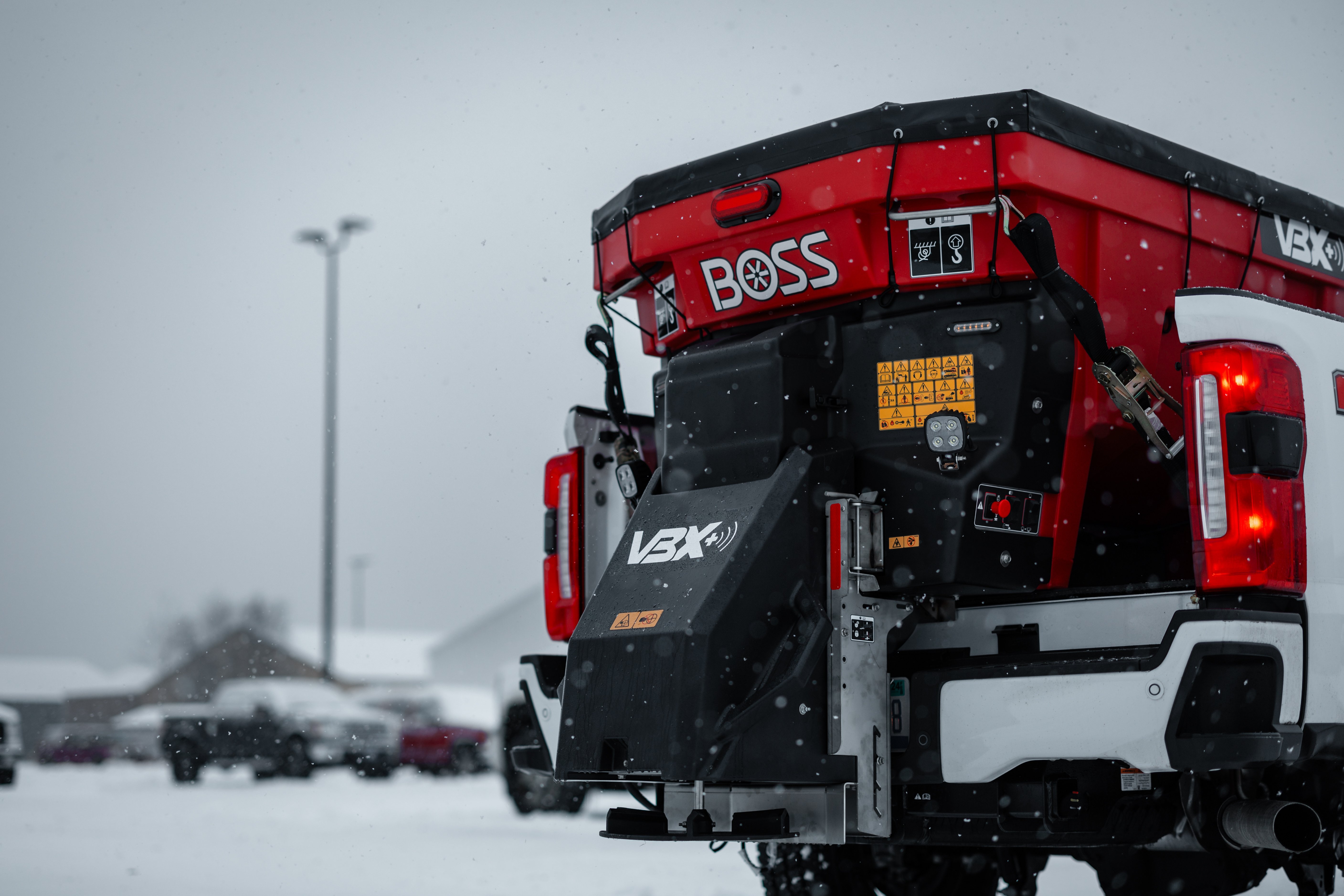
For pickup trucks and general commercial applications, consider a VBX+ hopper spreader.
-
For truck-bed hopper applications requiring greater capacity, the VBX+ offers 1.5-, 2-, and 3-cubic-yard configurations with auger or pintle feed options.
-
For large commercial and municipal operations, the MBX+ provides 4-, 5-, and 6-yard capacities and a high-output pintle chain feed system.
-
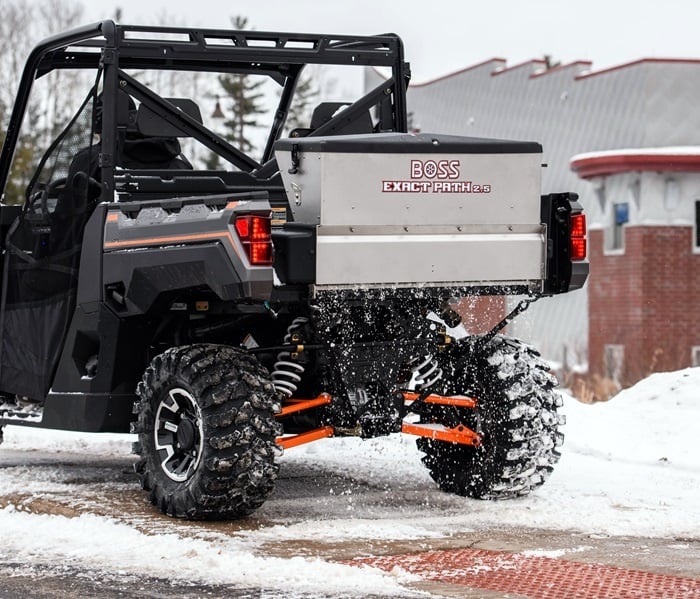
For UTVs, tractors, and compact equipment working around sidewalks and tight spaces, EXACT PATH provides controlled drop spreading.
-
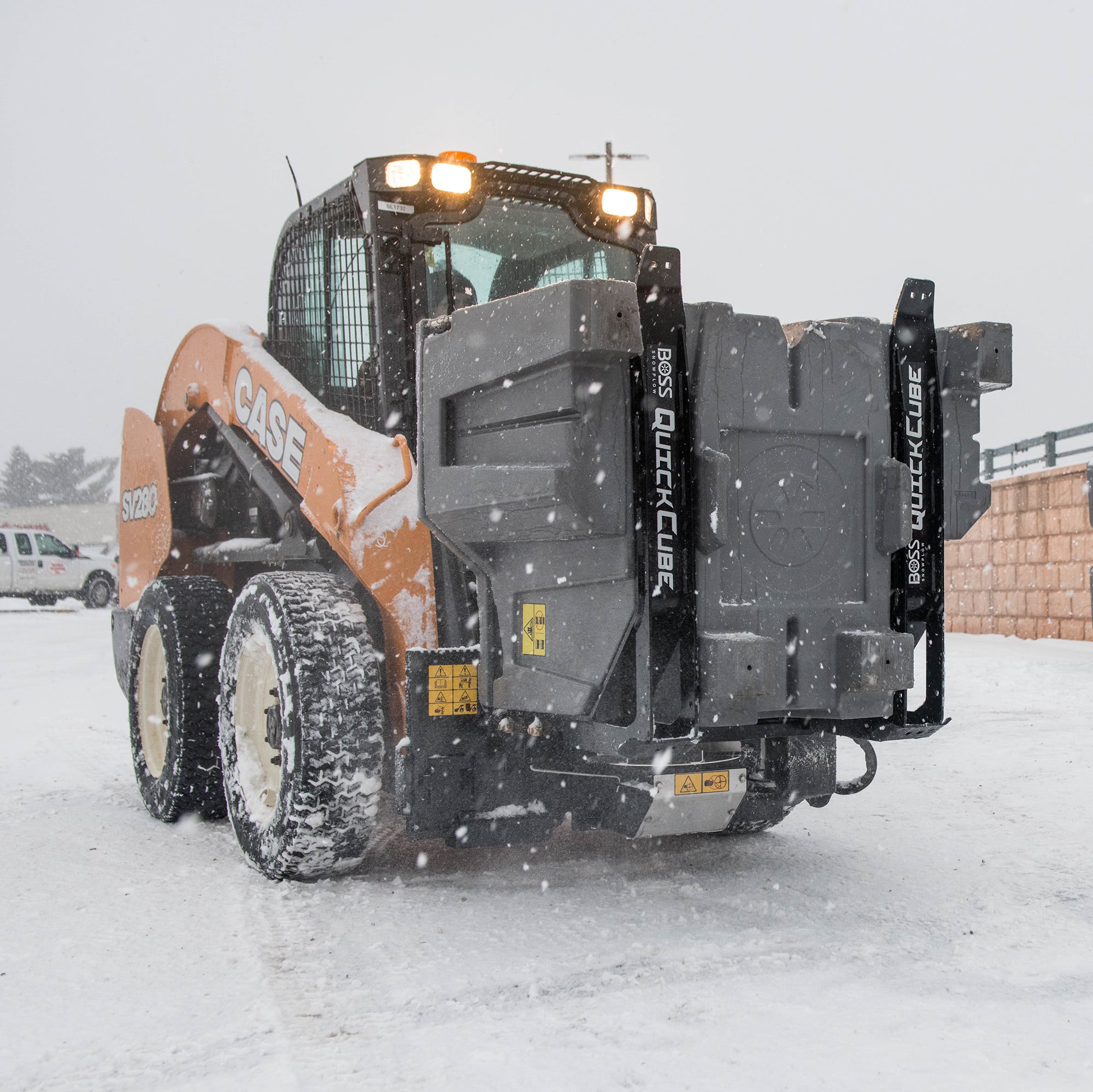
For skid-steer applications and jobsite material storage, QUICKCUBE offers a modular approach to material handling.
-
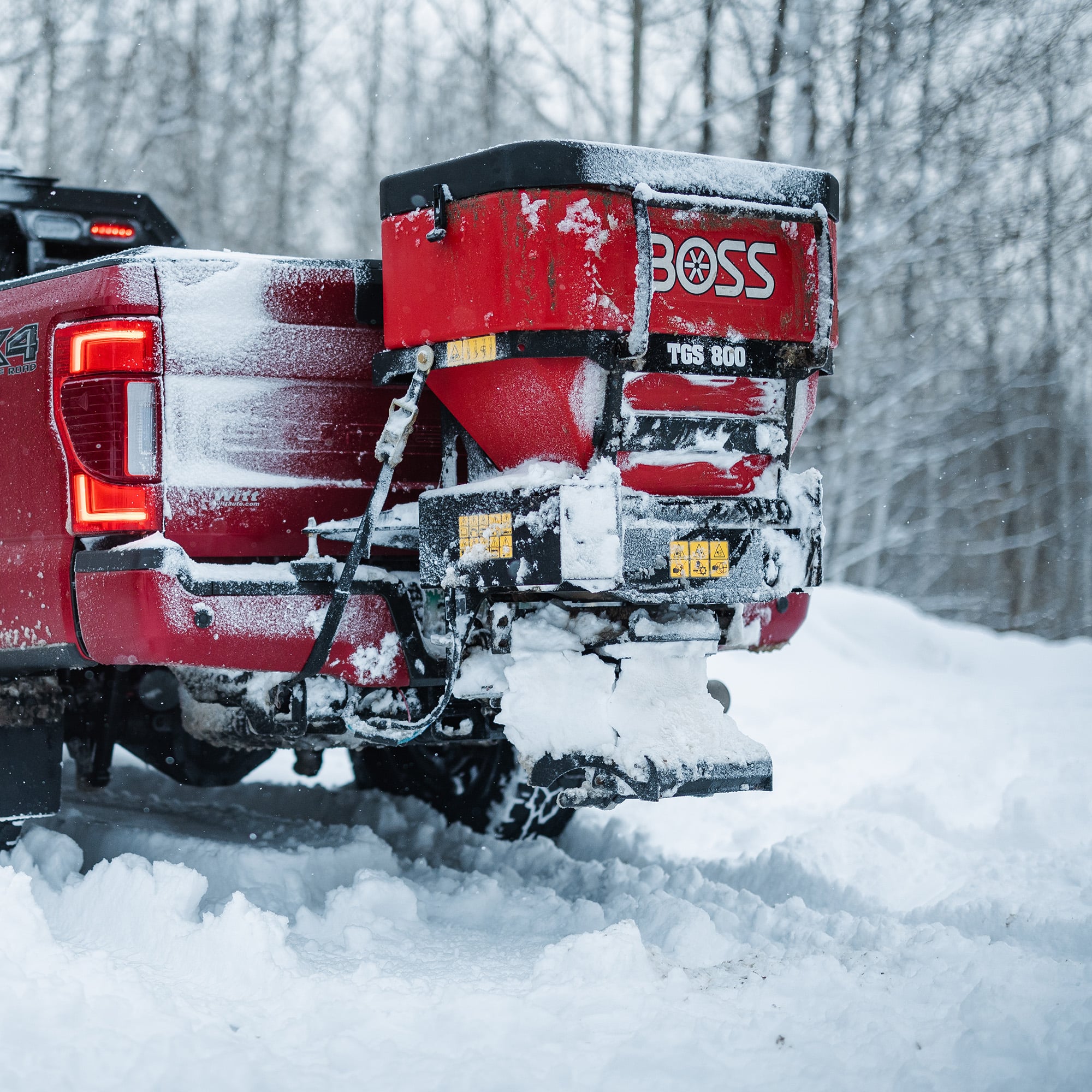
For smaller applications, BOSS TGS spreaders provide a compact way to carry and distribute deicing material.
-
-
The most important step is to match the spreader to both your vehicle and the material you plan to use.
What Is a Salt Spreader?
The right spreader helps operators apply material more consistently while matching equipment capacity and material flow to the needs of the job.
Before choosing a spreader, consider:
-
-
-
Vehicle size and compatibility
-
Hopper or material capacity
-
Type of deicing material
-
Required application rate
-
Desired spreading width
-
Size and type of jobs
-
How frequently the spreader will need to be refilled
-
-
How to Choose the Right BOSS Spreader
1. Start With Your Vehicle
Your vehicle is one of the first factors that should determine which spreader you choose. Different BOSS spreaders are designed for different vehicle types, sizes, and applications.
The BOSS Product Selector lets you enter your vehicle information and receive product recommendations based on your specific vehicle configuration.
As a general starting point:
-
-
-
Pickup trucks: TGS and VBX+ spreaders
-
Medium- and heavy-duty trucks: VBX+ and MBX+
-
UTVs and tractors: EXACT PATH
-
Skid steers: QUICKCUBE
-
-
Always verify vehicle compatibility and payload requirements before selecting a spreader.
2. Consider the Material You Need to Spread
Not every spreader is designed for every type of deicing material. BOSS categorizes common granular materials into three broad groups:
The BOSS Spreader Material Guide provides a visual reference for matching material types to compatible BOSS spreaders.
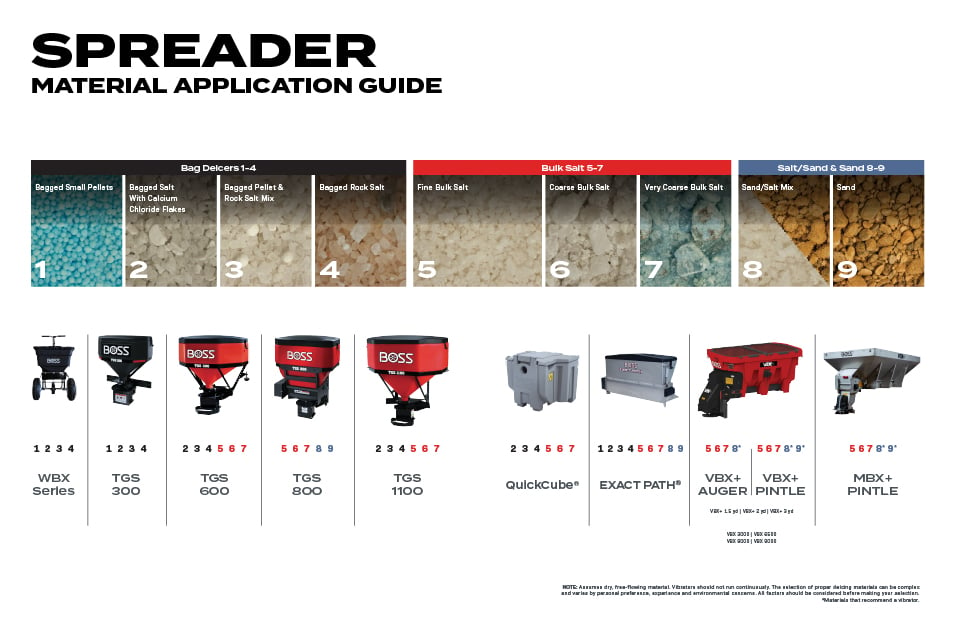
Use this guide to help identify compatible materials for BOSS spreader models.
3. Determine How Much Material You Need to Carry
Spreader capacity affects how often your crew needs to stop and reload.
For smaller routes or properties, a lower-capacity spreader may be easier to manage and can provide the right amount of material without adding unnecessary equipment weight.
For larger commercial routes, municipalities, campuses, and other high-volume applications, a higher-capacity hopper can reduce reload frequency and help crews stay productive during a storm.
Think about:
-
-
-
Average material usage per route
-
Number and size of properties serviced
-
Distance between reload locations
-
Expected storm duration
-
Available vehicle payload
-
How quickly your crew needs to complete each route
-
-
A larger spreader isn't automatically better. The goal is to select enough capacity to support the work without exceeding your vehicle's capabilities.
BOSS Spreader Options
VBX+
MBX+
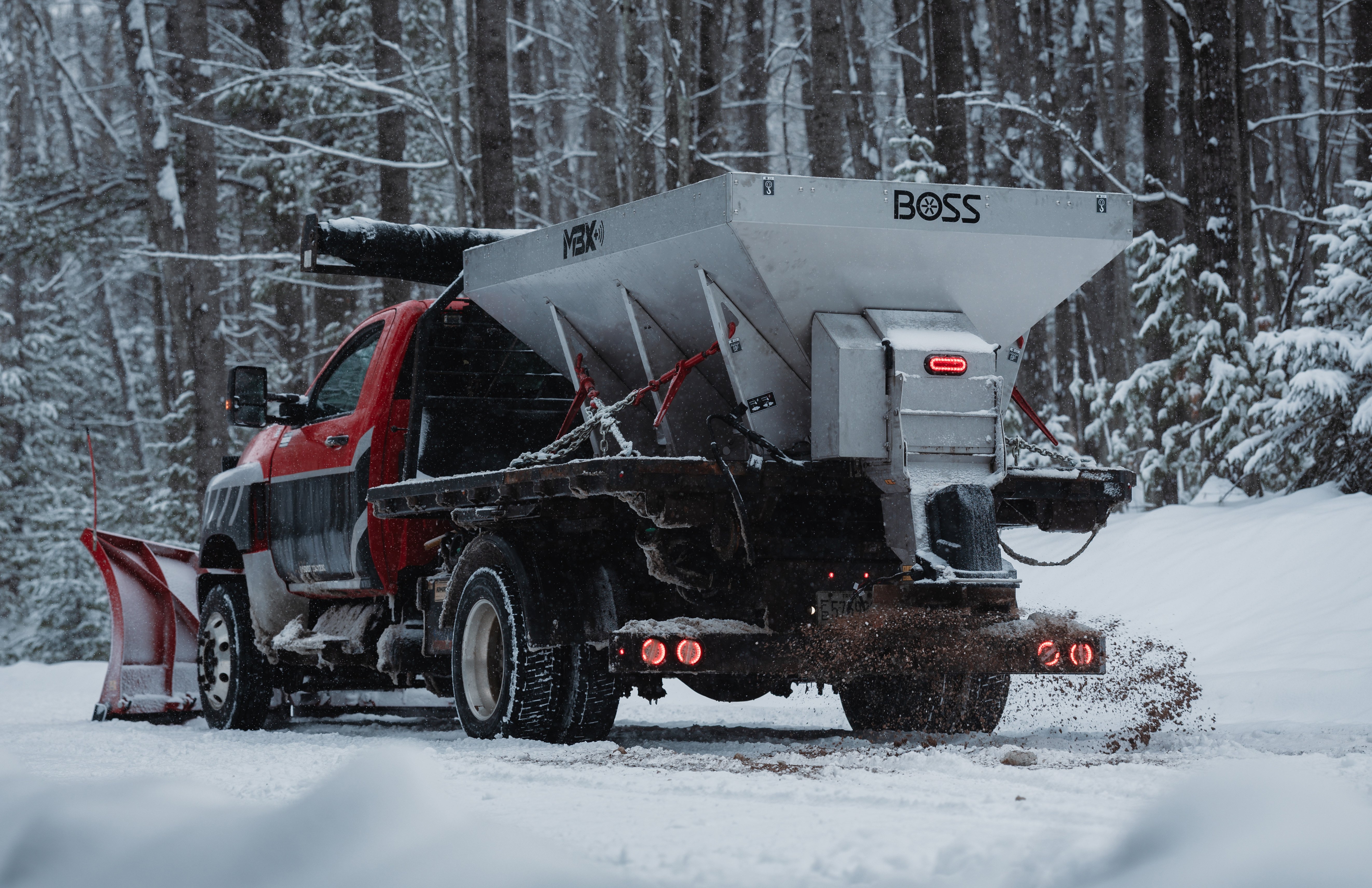
Key MBX+ features include:
-
-
-
4-, 5-, and 6-yard capacities
-
Heavy-duty stainless-steel construction
-
High-output pintle chain feed system
-
Up to 425 pounds of material flow per minute
-
Standard rate control
-
Job tracking for up to 10 job sites
-
Simplified material calibration
-
Optional AutoSpread Control
-
Flip-up spinner assembly
-
Compatibility with common flatbeds and dump bodies
-
-
When You Need More Capacity: MBX+
TGS Tailgate Spreaders
EXACT PATH
QUICKCUBE
BOSS Spreader Comparison
Always verify the material compatibility and vehicle requirements for the specific spreader configuration you are considering.
Choosing Between an Auger and Pintle Chain Spreader
If you're considering a hopper spreader, the feed system is another important decision.
In general, auger systems are well suited to dry, free-flowing salt and provide controlled material movement. Pintle chain systems can handle a broader range of materials, including sand and salt/sand mixtures, while providing higher maximum material flow.
The VBX+ is available with either an auger or pintle configuration, while the MBX+ uses a pintle chain feed system.
Need Help Choosing Your Spreader?
The right spreader isn't simply the one with the largest hopper or the highest material output. It should match your vehicle, material, route size, application requirements, and operating conditions.
Use the BOSS Product Selector to start with your vehicle and identify compatible equipment. Then use the BOSS Spreader Material Guide to confirm the appropriate material and spreader combination.
Related Resources
Auger vs. Pintle Chain: Which Hopper Spreader System Is Right for You?
Compare the two primary hopper feed systems and determine which is better suited to your material, operating conditions, and application needs.
How to Track, Optimize, and Reduce Salt Usage with BOSS Equipment
Learn how material tracking, rate control, calibration, and AutoSpread Control can help contractors better manage material usage and control costs.
How to Estimate Your Spreader Material Needs
Learn how material type, application requirements, and equipment can affect how much deicing material you need for a season.
BOSS Spreader Maintenance Tips
Keep your spreader ready for the season with maintenance guidance covering lubrication, chain tension, electrical connections, cleaning, and storage.
Frequently Asked Questions
How do I choose the right BOSS spreader?
Choose a BOSS spreader based on your vehicle, the type of material you need to spread, the amount of material you need to carry, and the requirements of your routes. Start by confirming vehicle compatibility, then consider spreader capacity, material compatibility, and feed system.
What is the difference between the VBX+ and MBX+?
The VBX+ is available in 1.5-, 2-, and 3-cubic-yard configurations and is designed for contractors who need hopper capacity and material-management features. The MBX+ is a higher-capacity spreader available in 4-, 5-, and 6-yard configurations for larger commercial and municipal applications.
What materials can BOSS spreaders handle?
Depending on the model and configuration, BOSS spreaders can handle materials including bulk salt, bagged deicers, sand, and salt/sand mixtures. Always check the specific spreader model and material application guide to confirm compatibility before use.
What is the difference between an auger and a pintle chain spreader?
An auger uses a rotating screw to move material through the hopper, while a pintle chain uses a conveyor-style chain. Auger systems are well suited to dry, free-flowing salt, while pintle chain systems offer greater material versatility and higher maximum flow.
What size BOSS spreader do I need?
The right spreader size depends on your vehicle's payload capacity, material usage, route size, and how frequently you want to reload. Smaller applications may benefit from a TGS, while higher-volume operations may require the greater capacity of a VBX+ or MBX+.
How can I find a BOSS spreader that fits my vehicle?
Use the BOSS Product Selector to enter your vehicle information and identify compatible BOSS equipment. You should also consider your material, application, and capacity requirements when making your final selection.