
Liquid Deicing Guide: Smarter Snow Management in Action
Liquid deicing boosts efficiency, reduces material use, and improves winter operations when applied with the right methods and equipment.

How does mechanical removal impact liquid usage?
Q: Can better plowing techniques reduce how much deicer I need?
A: Yes. The more snow and ice you remove mechanically, the less chemical product you’ll need afterward. Plows with floating edge systems or well-adjusted box plows help strip away compacted layers, setting up your liquid application for success.
What are ideal application rates for liquid deicers?
Q: What’s the standard GPA (gallons per acre) for liquids?
A:
-
Pre-treatment (anti-icing): 40–50 GPA
-
Post-treatment (deicing): 60–120 GPA
Moisture and conditions vary. Use situational management instead of fixed rates. For example, 60 GPA may be enough after a light glaze, but a thick snowpack may require 120 GPA.
Note: Many companies apply a flat 80 GPA post-storm, but this can lead to overuse or underperformance. With rate-controlled spray systems (like those from VSI), adjustments are easy and accurate.
What’s the best timing for liquid deicer application?
Q: When should I apply brine for best results?
A:
-
Pre-treat 24–48 hours before a storm
-
Extended coverage up to 120 hours if additives are used
-
Inter-storm application at the first sign of refreeze prevents bonding
-
Post-storm application should be adjusted based on how well the lot was cleared
Tip: Brine works best when it's used to prevent bonding—not after ice has fully set.
What about production and refill strategies?
Q: How can I make my operation more efficient?
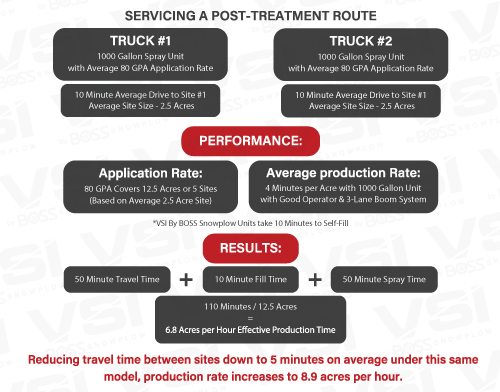
A: Set up localized refill stations. Ideal distance is within 10 minutes of your farthest site—or better yet, within 5 minutes.
Remote liquid stations are:
-
Faster and cheaper to set up than salt yards
-
Easier to refill and maintain
-
Less dependent on loaders or storage containers
This allows fewer trucks and sprayers to handle more work, especially during storms.
How pure should my salt be for mixing brine?
Q: Does salt purity affect liquid performance?
A: Absolutely. Salt used for brine making should be at least 95% pure. Poor-quality salt can cause mixing delays, system clogs, and even ineffective melting.
If your salt is underperforming, check the specs or switch to a higher-purity blend to improve results.