

How to Improve Snow Removal Route Profitability
Quick Answer
How to Make Snow Routes More Profitable
The most effective ways to improve route profitability are to:
-
-
-
Reduce unnecessary travel and route overlap.
-
Match equipment to the size and requirements of each property.
-
Track material usage by property instead of estimating overall salt consumption.
-
Calibrate spreaders and optimize application rates.
-
Reduce unnecessary labor and equipment idle time.
-
Improve plowing productivity by using the right plow configuration.
-
Plan for equipment reliability and minimize downtime.
-
Measure route performance after every significant snow event.
-
Use technology and data to identify recurring inefficiencies.
-
Price and schedule routes based on the actual time and resources required to service them.
-
-
The goal is not simply to do more work. It is to complete the same work with less wasted time, material, labor, and equipment capacity.
A profitable snow route is not simply one with enough accounts to keep crews busy. Profitability depends on how efficiently your team moves through the route, how much material it uses, how much labor each property requires, and how well your equipment performs throughout the snow event.
For snow removal contractors, small operational inefficiencies can add up quickly. Extra minutes at every property, unnecessary salt applications, inefficient routing, equipment downtime, and poorly matched equipment can turn a seemingly profitable route into a low-margin one.
The Three Major Areas That Impact Profitability
Improving snow removal business profitability starts with identifying where time, labor, material, and equipment costs are being lost—and fixing the biggest sources of waste first.
TIME
Travel, waiting, repositioning, and inefficient plowing reduce productive hours.
MATERIAL
Overapplication, poor calibration, and inefficient ice management strategies increase costs.
EQUIPMENT
Downtime, poor equipment matching, and idle machines reduce route productivity.
Interactive Calculator
Find Your Most Profitable Routes
See how differences in revenue and operating costs affect your route profitability. Compare up to six routes side by side and identify where your biggest opportunities are.
Compare Route Profitability →
What Determines Snow Removal Route Profitability?
A snow route's profitability can be simplified into a few major factors:
THE PROFITABILITY EQUATION
Revenue − Labor − Materials − Equipment − Overhead = Profit
While contractors cannot control every expense, they can significantly influence how efficiently resources are used.
For example, two contractors could charge the same amount to service the same group of properties but generate very different profits. One may use fewer trucks, complete the route faster, apply less salt, and experience fewer equipment problems. The other may spend more time traveling, use excessive material, and require additional labor.
The difference is operational efficiency.
For most contractors, the biggest opportunities for improvement fall into four categories:
-
-
Labor efficiency
-
Material efficiency
-
Equipment productivity
-
Route efficiency
-
Improving these areas can increase profit without necessarily requiring additional customers.
1. Reduce Unproductive Travel Time
One of the easiest ways to lose money during a snow event is to pay employees to drive instead of plow, push, or treat surfaces. Route inefficiency becomes especially expensive when crews are traveling between properties that could have been grouped more effectively.
Look for:
- Properties that require unnecessary backtracking.
- Routes that cross over themselves.
- Accounts located far outside your primary service area.
- Crews traveling through the same area multiple times.
- Properties that could be assigned to a different crew based on location.
- Long-distance travel between properties with short service times.
Even a few extra minutes per property can become significant over an entire route. For example, if a crew wastes just 10 minutes traveling or repositioning at each of 15 properties, that represents 150 minutes—or 2.5 hours—of lost productive time during the event. That time could mean fewer properties serviced, longer shifts, or additional labor costs.
Fix: Build routes around geography, not just account size
When assigning properties, consider:
-
-
Location
-
Property size
-
Required service frequency
-
Equipment requirements
-
Expected service time
-
Material requirements
-
Crew capabilities
-
The most profitable route is not necessarily the one with the most accounts. It is the one that allows the crew to service those accounts efficiently.
2. Match Equipment to the Property
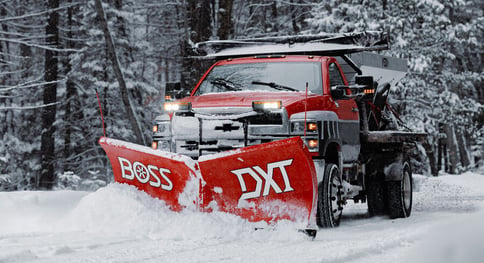
Equipment selection has a direct impact on snow removal productivity. Using equipment that is too small can increase service time. Using equipment that is unnecessarily large can increase operating costs and may not provide a meaningful productivity advantage.
The right equipment depends on the property. A small commercial lot may be efficiently serviced with a truck plow and spreader. A large parking lot may benefit from a larger plow, box plow, or combination of equipment. Sidewalks and pedestrian areas require equipment suited to their scale and accessibility.
Ask these questions for every account:
-
-
How much snow needs to be moved?
-
How large is the area?
-
Where can snow be stacked?
-
How much material is required?
-
How quickly does the property need to be reopened?
-
What equipment can access the property?
-
Can multiple pieces of equipment work simultaneously?
-
The objective is to minimize the amount of time and equipment required to complete the required work.
3. Measure Plowing Productivity
Not all plowing time is productive plowing time. A truck may be on a property for an hour, but that does not mean it spends an hour moving snow.
Time can be lost to:
-
-
Backing up
-
Maneuvering
-
Loading or unloading
-
Waiting for other equipment
-
Moving between sections of a property
-
Clearing around obstacles
-
Repeated passes caused by inefficient plowing patterns
-
Tracking actual service time can help identify these issues.
A simple productivity measurement
One useful measurement is:
Productivity = Area Serviced ÷ Time Required
You can also track:
Revenue per Labor Hour = Property Revenue ÷ Total Labor Hours
These numbers allow contractors to compare properties and crews based on more than revenue alone. A property generating $1,000 per event may look attractive until you discover it requires twice as many labor hours as another $1,000 property.
Improve Route Efficiency
How Productive Are Your Snow Routes?
Knowing how much ground your crew can clear per hour is one of the first steps toward building more profitable snow routes. Use the BOSS Snowplow Productivity Calculator to estimate clearing time, passes, material refills, and overall route productivity.
Calculate Your Snowplow Productivity →4. Reduce Snow Removal Labor Costs Without Reducing Service
Labor is often one of the largest variable costs during a snow event. That does not mean the solution is simply reducing headcount. The better approach is to reduce the amount of unproductive labor required to complete each route.
Look for labor spent on:
-
-
Waiting for equipment.
-
Waiting for other crew members.
-
Traveling between properties.
-
Loading material.
-
Repeatedly correcting inefficient plowing.
-
Manual work that could be completed with equipment.
-
Equipment breakdowns and troubleshooting.
-
Servicing properties that could be handled by a different crew or machine.
-
The goal is to increase the amount of productive work completed per labor hour.
Fix: Measure labor hours by route
Instead of looking only at total payroll for an event, track labor hours by route or crew.
Definition
Revenue per labor hour: The amount of revenue generated for every hour of labor required to service a property or route
For example:
|
Route |
Revenue |
Labor Hours |
Revenue/Labor Hour |
|
Route A |
$4,500 |
30 |
$150 |
|
Route B |
$4,500 |
42 |
$107 |
|
Route C |
$4,500 |
25 |
$180 |
All three routes generate the same revenue, but they are not equally profitable. This type of analysis can reveal where scheduling, equipment, property mix, or route design needs to change.
5. Stop Overapplying Salt
Material waste can have a major impact on profitability. When contractors apply more material than necessary, the additional salt does not automatically produce better results. It simply increases material costs and may create additional environmental or cleanup concerns. Snow removal material cost reduction starts with knowing how much material is being applied and where it is going.
Reduce Material Waste
Are You Using More Salt Than You Need?
Tracking material usage can help identify overapplication, improve route efficiency, and control one of the largest variable costs in snow and ice management. Learn how BOSS equipment helps contractors control application rates and track material usage by job.
Learn How to Track & Reduce Salt Usage →Track material usage by property
Instead of measuring salt consumption only at the yard level, track material usage by:
-
-
Property
-
Application
-
Event
-
Material type
-
Spreader
-
Application rate
-
This makes it possible to identify properties that consistently consume more material than expected. A contractor may discover that one property uses significantly more salt than similar properties because of its pavement conditions, application practices, or equipment calibration.

Smarter Material Management
Take Control of Every Application
Material costs can have a major impact on snow route profitability. BOSS AutoSpread technology helps contractors take greater control of material application so they can work toward more consistent spreading, less waste, and better control of operating costs.
Explore BOSS AutoSpread →Calibrate spreaders regularly
Spreader calibration helps ensure that the intended amount of material is actually being applied.
These factors can influence application rates:
-
-
Material type
-
Moisture content
-
Pintle chain or auger speed
-
Spinner speed
-
Gate settings
-
If the spreader is not calibrated, operators may be applying substantially more—or less—material than intended.

6. Use the Right De-Icing Strategy
Not every storm requires the same material strategy. Weather conditions, pavement temperatures, precipitation type, storm duration, and traffic all affect how contractors should approach ice control.
Depending on the conditions, contractors may use:
-
-
Liquid and/or granular pre-treatment
-
Granular de-icing
-
Liquid anti-icing
-
Liquid de-icing
-
Combination applications
-
Interstorm applications
-
A more strategic approach can help contractors reduce unnecessary material use while maintaining the required level of service.
Material Planning
How Much Spreader Material Do You Need?
Buying too little material can leave you scrambling during a storm, while buying too much can tie up cash and storage capacity. Learn how to estimate your deicing material needs before the season starts.
Estimate Your Material Needs →Liquid Ice Control
Could Salt Brine Improve Your Ice-Control Strategy?
Salt brine can be used as a pretreatment to help prevent snow and ice from bonding to pavement. Learn how timing, pavement conditions, and application strategy affect when brine can be most effective.
Learn About Salt Brine →Think in terms of prevention, not just reaction
Reactive applications after snow or ice has bonded to pavement can require more material and labor than preventing that bond in the first place. For appropriate conditions, liquid anti-icing applications can help prevent snow and ice from bonding to pavement, potentially making subsequent snow removal more efficient. The key is to select the application strategy based on the conditions rather than relying on the same approach for every event.
7. Reduce Equipment Downtime
Equipment that is sitting in the shop during a snow event is not generating revenue.
A breakdown can also create secondary costs:
-
-
Employee downtime
-
Overtime
-
Rental equipment
-
Route delays
-
Missed service windows
-
Additional trips
-
Customer dissatisfaction
-
For this reason, equipment reliability is part of snow event efficiency, not simply a maintenance concern.
Fix: Maintain equipment before the storm
Pre-event inspections should focus on the components most likely to affect productivity. Preventive maintenance is generally less disruptive than discovering a problem when a storm is already underway.
Snowplow Maintenance
Pre-Storm Snowplow Inspection
Before the storm, inspect:
- Hydraulic systems
- Cutting edges
- Trip mechanisms
- Attachment systems
- Electrical connections
- Lighting
- Hydraulic hoses
- Wear components
Is Your Plow Ready for the Next Storm?
Use this checklist to inspect critical components and help prevent equipment failures when your crews need their plows most.
Check Your Snowplow →Spreader Maintenance
Pre-Storm Spreader Inspection
Before the storm, inspect:
- Auger or pintle chain components
- Spinner
- Drive system
- Material flow
- Controls
- Electrical connections
- Mounting hardware (if applicable)
Keep Your Spreader Ready to Work
Learn the key maintenance steps for reducing premature component wear and keeping your BOSS spreader working reliably throughout the season.
Maintain Your Spreader →8. Minimize Equipment Idle Time
Equipment does not need to be broken to cost you money.
Idle equipment still consumes resources through:
-
-
Wear
-
Depreciation
-
Opportunity cost
-
One truck sitting idle while another crew is overloaded is an operational problem.
Fix: Balance equipment capacity across routes
Review how equipment is allocated during different stages of an event.
For example, during an initial snowfall, multiple plow trucks may be heavily utilized. Once accumulation slows, some trucks may have capacity while others are still completing difficult properties. A more flexible route plan can allow contractors to redeploy equipment where it will have the greatest impact.
9. Separate Plowing and De-Icing Decisions
Snow removal and ice control are related, but they are not always the same operation. A contractor can improve efficiency by thinking about each property in terms of: What needs to happen, when does it need to happen, and what equipment or material is best suited to accomplish it?
For example, a property may require:
-
-
Anti-icing before the storm.
-
Plowing during accumulation.
-
A targeted de-icing application after plowing.
-
A follow-up treatment if conditions change.
-
Planning these steps in advance can reduce unnecessary repeat visits.
10. Build Routes Around Service Requirements
Not every customer needs exactly the same level of service. A property with a strict zero-tolerance ice policy may require more frequent monitoring and treatment than a lower-priority property. Organize accounts according to their service requirements.
Route Strategy
Create Service Tiers for Your Snow Routes
Consider prioritizing properties based on access requirements, traffic levels, and service expectations:
Priority 1:
Critical access, high traffic, or strict service requirements
Priority 2:
Standard commercial properties
Priority 3:
Lower-traffic or less time-sensitive properties
This allows crews to prioritize resources during changing conditions. It can also prevent the common problem of treating every property exactly the same regardless of actual risk or contractual requirements.
11. Use Data From Previous Storms
Every snow event generates useful operational data. The problem is that many contractors do not consistently capture it.
After an event, review:
-
-
Total storm duration
-
Snowfall amount
-
Total labor hours
-
Labor hours by route
-
Material used
-
Material used per property
-
Equipment downtime
-
Fuel consumption
-
Number of service visits
-
Route completion time
-
Overtime
-
Customer issues
-
Then compare those results against previous events.
Post-Storm Review
Ask Three Questions After Every Storm
1. What took longer than expected?
Identify properties, routes, or processes that consistently consume more time.
2. What used more material than expected?
Look for properties or applications with unusually high material consumption.
3. Where did equipment or labor become a bottleneck?
These areas often represent the biggest opportunities for improving profitability.
12. Calculate Profitability at the Property Level
Revenue alone is not enough to determine whether an account is profitable. A better approach is to calculate the approximate cost of servicing each property.
Property Profitability Formula
Revenue − Labor − Materials − Equipment Costs − Other Variable Costs
This calculation can reveal accounts that appear valuable based on revenue but consume a disproportionate amount of time, material, equipment, or labor.
Example: Two $1,200 Properties
Both properties generate the same revenue, but the cost of servicing each one tells a very different story.
Property A
$1,200 Revenue
Labor: $350
Salt: $200
Equipment & operating costs: $150
Contribution
$500
Property B
$1,200 Revenue
Labor: $250
Materials & equipment: $150
Lower overall resource requirements
Contribution
$800
Same revenue. $300 more contribution to profitability.
Property B generates the same $1,200 in revenue but requires $300 less in variable costs, making it significantly more valuable to the snow removal operation.
This is why snow removal route profitability should be evaluated at the account and route level—not simply by total sales. The most valuable accounts aren't always the ones generating the most revenue; they're the ones that generate the strongest contribution relative to the resources required to service them.
interactive Route Profitability Calculator
Which Routes Are Actually Making You Money?
Revenue alone doesn't tell the whole story. Compare up to six routes based on revenue, costs, profit, and margin to see which routes are contributing the most to your bottom line—and which may need attention.
Compare Your Routes →13. Standardize What Can Be Standardized
Snow events are unpredictable, but your operating procedures do not have to be.
Create standard procedures for:
-
-
Pre-storm equipment inspections
-
Spreader calibration
-
Material loading
-
Route assignments
-
Property priorities
-
Plowing patterns
-
Post-event inspections
-
Equipment refueling
-
Maintenance reporting
-
Event closeout
-
Standardization reduces the number of decisions operators have to make during a stressful event. It also makes it easier to identify when something goes wrong.
14. Train Operators on Productivity, Not Just Equipment
An operator who knows how to use a plow is not necessarily an operator who knows how to use it efficiently. Training should cover more than basic equipment operation.
Operators should understand:
-
-
Efficient plowing patterns
-
Proper stacking techniques
-
Avoiding unnecessary passes
-
Safe and efficient maneuvering
-
Material application practices
-
Equipment limitations
-
Property-specific service requirements
-
When to report changing conditions
-
A small improvement in operator productivity can become significant when multiplied across an entire fleet.
15. Focus on the Biggest Profit Leaks First
Not every inefficiency deserves the same amount of attention. A contractor might spend hours trying to save a few dollars in fuel while losing thousands of dollars to inefficient routing or excessive labor. Prioritize improvements based on their financial impact.
A Simple Framework for Prioritizing Problems
Not every problem deserves the same level of attention. Use cost and frequency to determine where your team should focus first.
High Cost + High Frequency
Fix First
These problems have the greatest ongoing impact on profitability. Prioritize them before lower-impact issues.
High Cost + Low Frequency
Plan for It
These problems may not happen often, but they can have a significant financial impact when they do. Build a plan to reduce or manage them.
Low Cost + High Frequency
Automate or Standardize
Small inefficiencies can add up when they occur repeatedly. Look for ways to simplify, automate, or standardize the process.
Low Cost + Low Frequency
Monitor
These issues have relatively little impact. Keep an eye on them, but avoid spending disproportionate time or resources fixing them.
This helps keep operational improvement focused on changes that actually affect the bottom line.
A Practical Snow Route Profitability Checklist
Before the next major snow event, review your operation across these areas:
Snow Route Profitability Scorecard
Evaluate each route across five operational areas. The goal is to identify where time, labor, materials, equipment, or revenue are creating opportunities to improve profitability.
Route Efficiency
Look for:
- Properties grouped geographically
- Unnecessary backtracking
- Excessive crew travel time
- Clearly defined service priorities
Labor
Look for:
- Labor hours required per route
- Crew waiting or idle time
- Tasks that could be eliminated or automated
- Properties requiring excessive labor
Materials
Look for:
- Proper spreader calibration
- Application rates matched to conditions
- Material quantities tracked by property
- Accounts with consistently high material use
Equipment
Look for:
- Equipment matched to property requirements
- Pre-event equipment inspections
- Machines with recurring downtime
- Equipment bottlenecks during peak operations
Financial Performance
Measure:
- Revenue per labor hour
- Material cost per property
- Approximate profit per account
- Contribution by route
- Underperforming accounts
The goal: Don't just identify what is costing your operation money. Determine where those costs are coming from, how often they occur, and which changes could have the greatest impact on route profitability.
The Goal: More Profit From the Same Snow Route
Improving snow removal business profitability does not always require adding more customers. In many cases, the opportunity is already sitting inside the routes you operate today.
Reducing 10 minutes of wasted time at multiple properties, lowering unnecessary material consumption, improving equipment productivity, or eliminating a recurring equipment failure can have a measurable impact across an entire season.
The most profitable snow contractors treat every snow event as an opportunity to learn.
Track what happened. Identify where time, labor, material, and equipment capacity were lost. Then make one operational improvement before the next storm. Over an entire winter, those small improvements can compound into significantly more profitable routes.
Want to Find Your Biggest Productivity Opportunities?
Start by measuring how much time your crews spend servicing each property, how much work they complete, and what each route is actually contributing to your bottom line. Our Route Profitability Calculator makes that comparison easier by letting you compare the revenue, costs, profit, and margin of up to six routes side by side.
Use the calculator to identify which routes are performing well, which ones are consuming too much labor or material, and where operational changes could have the greatest financial impact. Once you know where the biggest profit leaks are, you can make more informed decisions about routing, equipment, labor, materials, and service requirements.
The goal isn't simply to clear more snow.
It's to clear snow more efficiently, with less waste, and turn every route into a stronger contributor to your bottom line.
Frequently Asked Questions
How can I make my snow removal business more profitable?
You can improve snow removal business profitability by reducing unproductive travel time, matching equipment to each property, improving crew productivity, controlling labor and material costs, reducing equipment downtime, and evaluating the profitability of individual routes.
How do I know if a snow removal route is profitable?
Compare the revenue generated by a route with its labor, material, equipment, fuel, and other operating costs. Looking at profit and profit margin at the individual route level can help identify which routes are performing well and which may need attention.
How can I reduce snow removal labor costs?
Reduce labor costs by minimizing unproductive travel and waiting time, matching equipment to the property, improving route planning, standardizing repeatable tasks, and tracking how much work crews complete during each snow event.
How can I reduce material costs on snow removal routes?
Use appropriate application rates, calibrate spreaders, track material usage, and review application data by job or route. Better material management can help reduce overapplication and control one of the largest variable costs in snow and ice management.
How can I improve snow removal productivity?
Measure how much work crews complete during a given period and look for sources of lost time, including inefficient travel, excessive turning, equipment changes, material refills, and equipment downtime. Comparing productivity across routes can help identify opportunities for improvement.
How can I compare the profitability of different snow routes?
Compare revenue, operating costs, profit, and margin for each route. The Route Profitability Calculator lets you compare up to six routes side by side to help identify differences in financial performance and potential opportunities to improve route profitability.
What is the biggest factor affecting snow route profitability?
There is no single factor that determines profitability. Revenue, labor, material use, equipment costs, fuel, travel time, productivity, and service requirements can all affect how profitable a route is. Evaluating these factors together provides a clearer picture of route performance.