

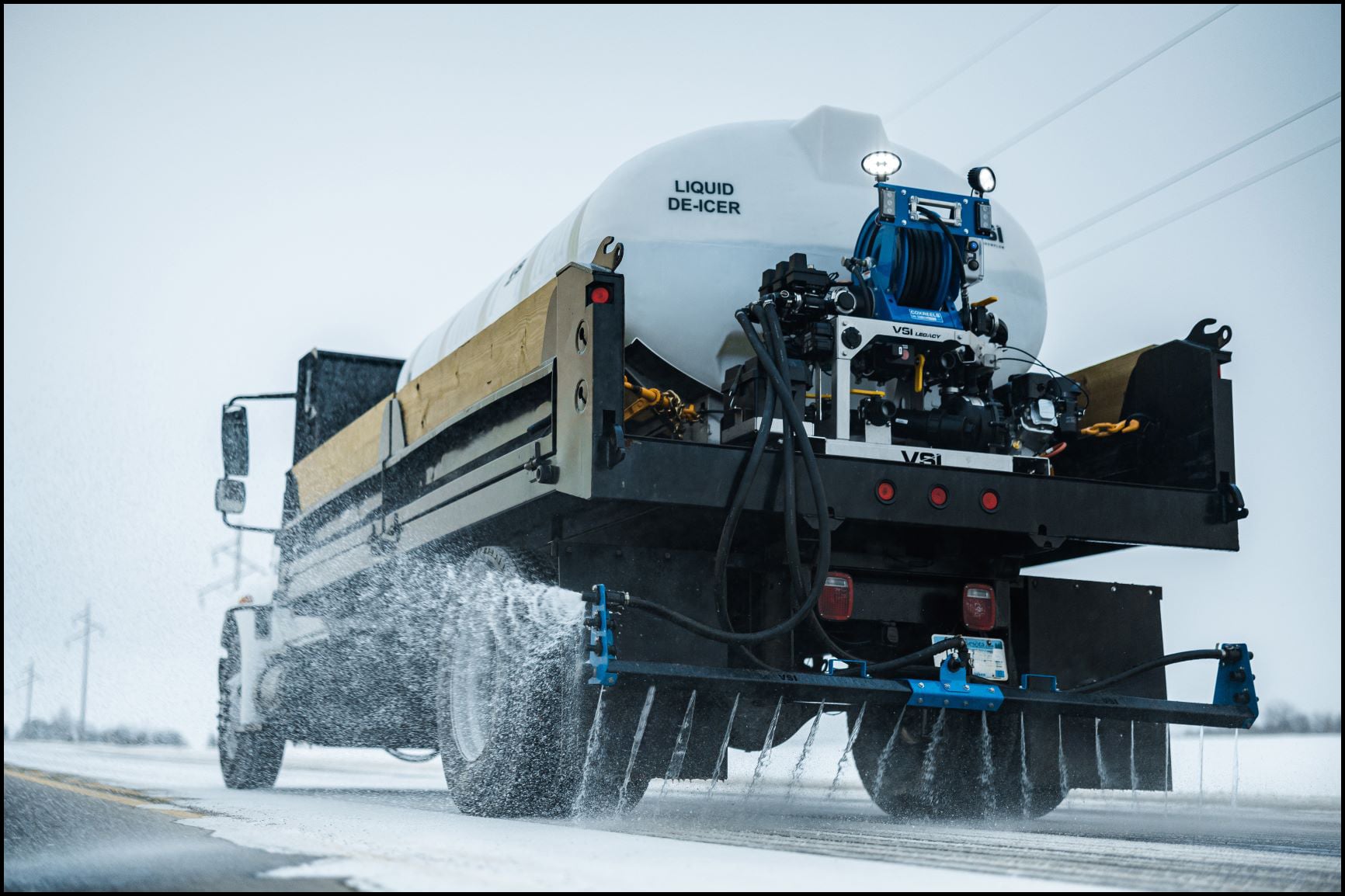
How Liquid De-Icing Helps Contractors Cut Salt Use and Improve Profitability
Key Takeaways
Liquid de-icing helps contractors reduce salt usage, improve melting performance, shorten service times, and lower operating costs by applying liquid before, during, or after winter storms. While equipment requires an upfront investment, many contractors see long-term savings through reduced material use, fewer callbacks, and increased productivity.
What You'll Learn
By the end of this article, you'll understand:
- How liquid de-icing works
- The difference between anti-icing and de-icing
- Why liquids reduce salt usage
- When contractors should pre-treat pavement
- How to calculate liquid equipment ROI
- Which contractors benefit most from liquid systems
- Common mistakes new users make
- Whether switching to liquids makes financial sense
Every winter, snow contractors face the same challenge: rising salt costs, inconsistent supply, tighter environmental regulations, and customers expecting safer surfaces faster than ever.
For many contractors, simply spreading more rock salt isn't the answer.
Liquid de-icing offers a smarter approach.
By applying liquid before or during winter weather events, contractors can reduce total salt usage, improve melting performance, minimize callbacks, and provide a higher level of service without simply increasing material costs. Whether you're exploring liquid application for the first time or evaluating the return on a new anti-icing system, understanding how liquid de-icing works is the first step.
At the end of this guide, you can use our free Liquid De-Icing Savings Calculator to estimate how reducing salt usage could impact your operation.
What Is Liquid De-Icing?
Liquid de-icing is the application of liquid brine (a liquid salt solution) or enhanced liquid solutions to pavement before, during, or after winter storms to prevent ice from bonding to the surface and to improve melting efficiency.
Unlike dry rock salt that must first dissolve before becoming effective, liquids begin working immediately because the active solution is already in liquid form.
Most contractors use liquids in one of three ways:
- Anti-icing (pre-treatment before precipitation)
- Pre-wetting rock salt during application
- Post-treatment after plowing
Each method can reduce total material usage while improving pavement conditions.
Liquid De-Icing vs. Traditional Rock Salt
Liquid de-icing and granular rock salt both help manage snow and ice, but they work differently. Understanding when and how each method performs best can help contractors reduce material waste, improve service quality, and choose the right strategy for each storm.
| Category | Liquid De-Icing | Rock Salt |
| Starts Working | Immediately | Must dissolve first |
| Coverage | Even coating | Granular distribution |
| Bounce & Scatter | None | Moderate to high |
| Material Waste | Lower | Higher |
| Environmental Impact | Reduced chloride use | Higher chloride load |
| Callback Risk | Often lower | Can be higher |
| Initial Investment | Higher | Lower |
Bottom line: Liquid de-icing isn't a replacement for rock salt in every situation. Many successful snow contractors use both methods together—applying liquids for anti-icing and pre-wetting while relying on granular salt when conditions require it. The goal isn't to eliminate rock salt; it's to use it more efficiently.
Why Contractors Are Using More Liquid De-Icing
Several industry trends are driving adoption:
One: Rising Salt Costs
Salt prices continue to fluctuate based on supply, transportation, and winter severity. Every unnecessary pound spread directly impacts profitability. Liquid applications help place material more precisely where it's needed.
Two: Salt Shortages
Many contractors have experienced supply limitations during severe winters. Reducing overall consumption makes available inventory last longer.
Three: Higher Customer Expectations
Commercial property owners increasingly expect:
- Faster melting
- Cleaner pavement
- Less tracking into buildings
- Fewer repeat service calls
Liquid applications help meet those expectations while using less material.
Expert Insight
"Liquids are one of the easiest ways for a contractor to control their salt usage and their supply."
— Jordan Smith, a liquids industry expert and CEO of Storm Equipment
Wondering what those savings could look like?
Every contractor's operation is different. The amount you could save depends on factors like salt usage, route size, labor costs, and the number of winter events you service each season.
Keep reading to learn how liquid de-icing reduces costs, then use our free Liquid De-Icing Savings Calculator at the end of this article to estimate your potential savings.
How Liquid De-Icing Reduces Salt Use
1. Anti-Icing Prevents Bonding
Anti-icing is the practice of applying liquid before snow begins to accumulate, thus preventing ice from bonding to the pavement. Applying liquid before precipitation creates a protective layer between pavement and snow.
Instead of scraping bonded ice after the storm, plows remove snow and ice much more easily because the bond never fully develops.
This often results in fewer post-storm salt applications.
2. Better Material Coverage
Liquid sprays provide uniform coverage across pavement.
Unlike granular salt, which can bounce, scatter, or be thrown beyond the intended target, liquids remain where they're applied.
That means less waste and more consistent treatment.
3. Faster Activation
Rock salt must absorb moisture before it begins melting ice.
Liquid products are already activated.
This means:
- faster melting
- quicker response
- improved performance in changing conditions
4. Improved Salt Performance
Many contractors use liquids to pre-wet rock salt during spreading.
Benefits include:
- reduced bounce
- reduced scatter
- improved adhesion
- greater melting efficiency
Instead of simply putting more chloride on the pavement, liquid applications maximize the effectiveness of every pound of material.
Because liquid adheres to the pavement and begins working immediately, contractors often achieve the same or better melting performance while using less total salt.
The result isn't necessarily "more melting"—it's more efficient melting.
Expert Insight
"As a contractor, when we use liquids as a pre-treatment, we can often save 30% on salt right there. Contractors already pre-salting with granular products can apply significantly less material with liquids, while those who weren't pre-treating often find they need much less salt after plowing because the pavement scrapes cleaner."
— Jordan Smith
Pre-Treatment Applications: Why Timing Matters
One of the biggest advantages of liquid systems is the ability to perform pre-treatment applications before snow begins.
Benefits include:
- prevents hard-packed snow
- minimizes ice bonding
- speeds plowing
- reduces labor hours
- decreases salt required after plowing
Waiting until ice has already bonded often requires significantly more material and labor than preventing the bond in the first place.
Service Quality Improves Alongside Salt Reduction
Reducing salt isn't just about lowering costs.
Liquid applications often improve overall service quality by helping contractors:
- achieve more consistent pavement conditions
- reduce icy patches
- shorten service times
- reduce customer complaints
- minimize return visits
For many companies, those operational improvements are just as valuable as material savings.
Calculating Your De-Icing ROI
Many contractors focus only on equipment cost.
A better question is:
How much does inefficient salt application cost every season?
When Evaluating a Liquid System, Consider:
| Cost Factor | Traditional Salt | Liquid Program |
| Salt Consumption | Higher | Lower |
| Repeat Applications | More frequent | Often reduced |
| Labor Hours | Higher | Often lower |
| Fuel Usage | Higher | Often lower |
| Equipment Wear | Higher | Reduced |
| Customer Satisfaction | Variable | Often improved |
Expert Insight
"On average, a contractor that's using liquids as both a pre-treatment and a post-treatment is getting about a 70% reduction in the amount of salt they need to use. While results vary, implementing liquid as a pre-treatment alone often allows contractors to make their salt go 30–40% further."
— Jordan Smith
Run the Numbers
Rather than estimating these savings on paper, use the Liquid De-Icing Savings Calculator at the end of this article to see how changes in salt consumption and operating costs could affect your business.
When Does Investing in Liquid Equipment Make Sense?
Not every contractor needs the same setup.
Smaller operations may begin with portable sprayers or pre-wetting systems.
Larger commercial contractors often benefit from dedicated truck bed sprayers capable of treating parking lots, roads, sidewalks, and campuses efficiently.
Modern systems may also include features like:
- GPS rate control
- Bluetooth or app-based controls
- adjustable application rates
- multiple tank capacities
- integrated job tracking
These technologies help contractors apply consistent rates while reducing over-application and material waste.
Common Misconceptions About Liquid De-Icing
"Liquids replace rock salt."
Not entirely.
Most successful contractors use liquids alongside granular materials, choosing the best application method based on weather conditions.
"Liquids only work before storms."
While anti-icing is extremely effective, liquids are also valuable for post-treatment and pre-wetting rock salt.
"It's too expensive to get started."
Initial equipment investment should be compared against:
- reduced salt purchases
- fewer labor hours
- lower fuel costs
- fewer callbacks
- improved customer retention
For many commercial contractors, these savings accumulate over multiple seasons.
Frequently Asked Questions
-
Does liquid de-icing reduce salt usage?
Yes. Liquid de-icing can reduce overall salt consumption by improving application efficiency, preventing ice bonding, and reducing unnecessary reapplications.
-
What is anti-icing?
Anti-icing is the practice of applying liquid de-icer before precipitation begins to prevent snow and ice from bonding to pavement.
-
Can liquid de-icing be used with rock salt?
Yes. Many contractors pre-wet rock salt with liquid to reduce bounce, improve adhesion, and increase melting performance.
-
Can I use liquid de-icing during every snow event?
Liquid de-icing can be used during many winter weather events, but the best application strategy depends on pavement temperature, precipitation type, storm intensity, and timing. Anti-icing is most effective before precipitation begins, while liquid de-icers and pre-wetting techniques can also improve performance during and after a storm. Monitoring weather forecasts and pavement conditions helps determine the right approach for each event.
-
Is liquid de-icing worth the investment?
For contractors servicing commercial properties or managing large snow routes, reduced material usage, lower labor costs, and improved service quality can provide a strong long-term return on investment.
-
What liquid is used for de-icing?
Most liquid de-icing programs use salt brine made from sodium chloride, although calcium chloride and magnesium chloride solutions are also common for lower-temperature applications. Some contractors also use enhanced brines containing additives that improve adhesion, reduce corrosion, or extend performance under certain weather conditions.
-
Is liquid de-icing better than rock salt?
Neither method is universally better—they're designed for different purposes. Liquid de-icing excels at preventing snow and ice from bonding to pavement and improving application efficiency, while granular rock salt is often used to treat accumulated snow and ice. Many professional snow contractors achieve the best results by combining both methods, using liquids for anti-icing and pre-wetting while relying on rock salt when additional melting power is needed.
The Bottom Line
Liquid de-icing isn't simply another product—it's a different approach to winter maintenance. By focusing on prevention rather than reaction, contractors can reduce salt consumption, improve application consistency, shorten service times, and deliver better results for customers. As labor and material costs continue to rise, adopting liquid de-icing may become one of the most effective salt reduction strategies available to commercial snow professionals.
Every operation is different, however. Factors like route size, seasonal salt usage, labor costs, and the number of winter events all influence the potential return on investment. Before deciding whether liquid application equipment is right for your business, use the Liquid De-Icing Savings Calculator below to estimate how reducing salt usage could affect your bottom line.
Liquid De-Icing Playbook
Liquid De-Icing Savings Calculator
Estimate how much switching from rock salt to liquid brine could save your operation — per event and per season.
Your Operation
Application Rates
Additive & Input Costs
Defaults to $0. Enter your own numbers if you blend an additive into your brine.
Brine is calculated at 2.28 lbs of salt per gallon of water (23.3% saturation), the eutectic point for maximum melting efficiency.
Estimated savings per event
$1,692
vs. traditional rock salt on the same acreage
| Rock Salt | Liquid Brine | |
|---|---|---|
| Salt Used | ||
| Pre-treatment | 0.0 tons | 0.0 tons |
| Post-treatment | 0.0 tons | 0.0 tons |
| Total salt used | 0.0 tons | 0.0 tons |
| Material Cost | ||
| Pre-treatment cost | $1,750 | $919 |
| Post-treatment cost | $3,500 | $2,638 |
| Total per event | $5,250 | $3,558 |
Over 12 events this season, switching to liquid could save approximately
$20,304
At this rate, a $15,000 equipment investment pays for itself in approximately 9 events (about 0.7 seasons).
Cost isn’t the whole story
At these settings, liquid material costs run close to or above rock salt. However, liquid de-icing works faster, prevents ice from bonding to pavement in the first place, cuts callbacks, causes less damage to concrete, asphalt, and landscaping, and doesn’t track into buildings the way rock salt does. Those service-quality and customer-retention benefits often matter as much as the material cost itself.
Figures are estimates for illustrative purposes only, based on the application-rate and blending methodology in BOSS Snowplow's Liquid Deicing Playbook. Actual costs vary by market, equipment, weather, and site conditions.