

How to Calculate Snowplow Productivity Per Hour in 7 Steps
Knowing your snowplow productivity per hour can make or break your winter season. If you're managing a diverse portfolio of customers, accurate productivity estimates help you schedule routes, price jobs correctly, and avoid overcommitting your crews.
Snowplow Productivity Calculator Summary
To estimate snowplow productivity per hour:
- Measure your lot or route size
- Determine your plow's effective pass width
- Estimate your average plowing speed
- Calculate passes required per lot
- Account for turn time and stacking
- Factor in spreader refill cycles
- Calculate your total productivity rate
BOSS Snowplow gives you the equipment and configurations to maximize your lot clearing time and route planning efficiency. This guide walks you through a straightforward method for calculating how much ground you can cover per hour—and how to optimize your setup for faster turn times.
By the end, you'll have a worksheet-style framework you can apply to any lot or route in your service area.

How to Estimate Your Snowplow Lot Clearing Productivity
Step One: Measure your lot or route size
For routes with multiple stops, add up the total acreage across all properties. Keep a spreadsheet with each lot's dimensions so you can reference it quickly during bidding season. Accuracy matters here.
Underestimating lot size leads to rushed work and unhappy clients. Overestimating wastes valuable time you could spend on other jobs.
Step Two: Determine your plow's effective pass width
Effective pass width is the actual width of snow cleared in a single pass after accounting for the blade angle, which is often narrower than the plow's advertised width.
For example, BOSS V-plows like the DXT series have a 98-inch blade width when straight. At a 30-degree angle, the effective plowing width drops to around 85 inches.
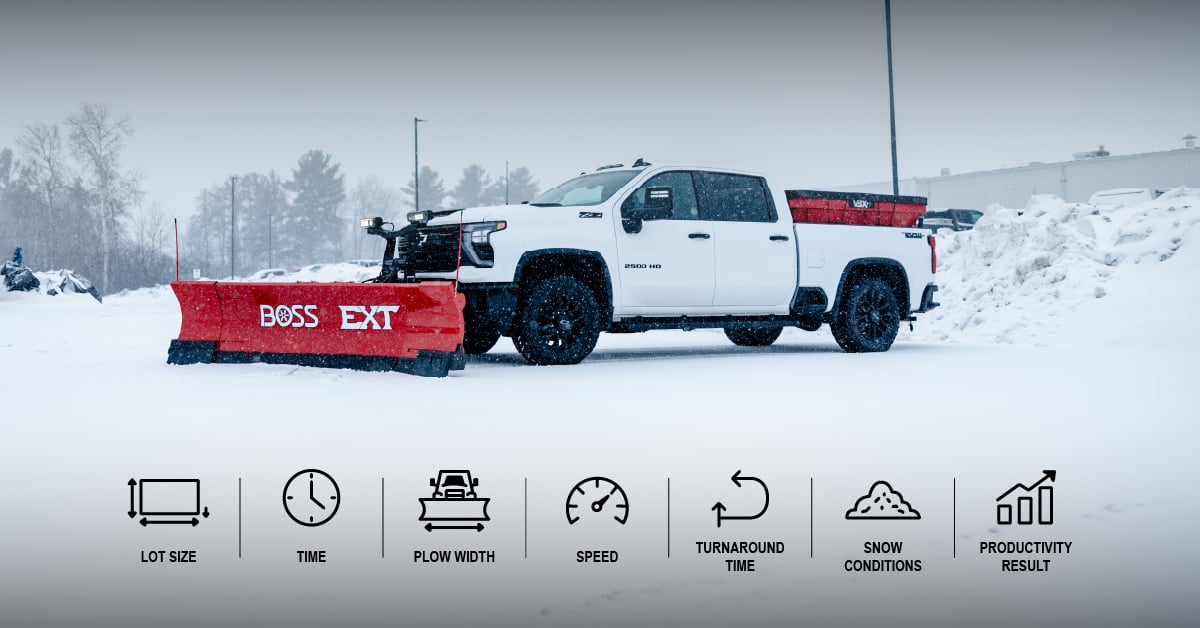
Expandable plows like the BOSS EXT let you adjust from 8 to 10 feet, giving you flexibility for different lot configurations. Write down your effective width for each blade position. You'll use this number in your calculations.
Step Three: Estimate your average plowing speed
For light snow (2 inches or less), most contractors plow at 8-14 mph. Heavier accumulations of 4-6 inches typically slow you down to 5-10 mph. Beyond 6 inches, speeds often drop to 3-7 mph. Parking lots with islands, light poles, and curbs require slower speeds than open roads or lots.
Be conservative in your estimates—it's better to finish early than to scramble when conditions get tough.
Step Four: Calculate passes required per lot
To find the number of passes, divide the lot width by your effective pass width. Round up to the nearest whole number since partial passes still take a full trip.
Here's a simple formula: Number of passes = Lot width ÷ Effective pass width
For a 200-foot-wide lot using an 85-inch (approximately 7-foot) effective pass width, you'd need about 29 passes to cover the full area. Each pass takes time, so this number directly affects your hourly productivity.
Step Five: Account for turn time and stacking
Straight-line plowing is only part of the job. At the end of each pass, you need to raise the blade, turn around, lower the blade, and position for the next run. This typically adds 15-30 seconds per turn. Snow stacking at lot edges adds more time. Pushing snow to the perimeter and building piles can take 5-15 minutes per lot, depending on accumulation and available stacking space. Include a 20-25% buffer in your time estimates to cover these transitions.
Experienced operators develop efficient patterns that minimize wasted movement—something that comes with practice.
Step Six: Factor in spreader refill cycles
Ice control is part of most snow removal contracts. Your spreader capacity and application rate determine how often you'll need to refill during a route. BOSS hopper spreaders like the VBX+ hold varying amounts depending on the model. A typical application rate of 200-400 pounds of salt per acre means a 2-cubic-yard spreader can cover roughly 8-12 acres before needing a refill.
Each refill stop adds time to your route, including drive time to your salt stockpile and loading time. Map out refill locations in advance and factor these stops into your productivity calculations.
Step Seven: Calculate your total productivity rate
Now combine all your variables into a productivity formula. A snowplow productivity formula estimates acres cleared per hour by combining effective plow width, travel speed, and an efficiency factor to account for real-world operating conditions.
Pro Tip: Multiply by an efficiency factor. An efficiency factor is a percentage used to adjust theoretical productivity calculations to account for turning, obstacles, travel time, snow stacking, and operator delays. Start with an efficiency factor between 60% to 80% until you get a strong idea of your own or your crews' efficiency.
How to apply an efficiency factor: A 7-foot effective width at 10 mph yields a theoretical rate of about 8.5 acres per hour. With a 0.7 efficiency factor, your realistic productivity drops to approximately 6 acres per hour.
Here's a simplified version you can adapt:
Productivity (acres/hour) = [[Effective pass width (ft) × Speed (mph) × 5,280] ÷ 43,560] x Efficiency Factor
Where:
Effective Width = actual clearing width
Speed = average plowing speed
Efficiency = 60-80%
What Factors Affect Snowplow Clearing Speed the Most?
Several factors influence how quickly a snowplow can clear a parking lot or driveway, but snow depth and snow weight have the greatest impact. Wet, heavy snow is much denser than light, powdery snow, creating more resistance against the blade and requiring slower speeds or multiple passes. Even a few inches of heavy, moisture-rich snow can take significantly longer to clear than a deeper accumulation of dry snow.
Snow Depth vs. Productivity
| Snow Depth | Typical Speed | Estimated Productivity |
| 1-2" | 10-14 mph | High |
| 2-4" | 8-12 mph | Moderate |
| 4-6" | 5-10 mph | Reduced |
| 6-10" | 3-7 mph | Low |
| 10"+ | 1-5 mph | Very Low |
Equipment choice matters too. V-plows handle deep snow more effectively than straight blades because they can break through drifts and windrow snow to both sides. Box plows excel at large, open lots where containment is important.
Site complexity plays a significant role. Lots with numerous obstacles—light poles, shopping cart corrals, curbed islands—require constant speed adjustments and careful maneuvering. Open lots let you maintain higher speeds and more consistent patterns.
Finally, operator experience affects productivity more than many people realize. Skilled operators develop efficient routes, minimize backing distance, and know exactly when to stack versus push through.
How Do You Improve Route Planning Efficiency for Snow Removal?
Efficient route planning starts long before the first snowflake falls. Group properties by geographic location to reduce windshield time and fuel costs while maximizing the amount of time spent plowing.
Prioritize your route based on customer expectations and site requirements. High-traffic commercial properties, medical facilities, and locations with strict service agreements often need to be serviced before lower-priority accounts. Planning these priorities in advance helps eliminate last-minute decisions during a storm.
Keep equipment operating efficiently by planning fuel, deicing material, and maintenance stops. Reducing unnecessary trips back to the shop or other locations keeps your crews productive and minimizes downtime.
Finally, track your actual completion times throughout the season. Comparing estimated versus actual plowing times helps you identify bottlenecks, optimize future routes, improve scheduling, and build more accurate estimates for future contracts.
How BOSS Snowplow Helps You Maximize Lot Clearing Productivity
BOSS Snowplow builds equipment designed to help you clear more ground in less time. Cold Front Technology lets you connect your plow and spreader to a shared truck harness, reducing setup time between jobs.
V-plows like the BOSS DXT give you multiple blade configurations—scoop, V, and straight—so you can adapt to changing snow conditions while Dual-Trip technology helps protect both the truck and plow from hidden obstacles. The expandable EXT plow adjusts from 8 to 10 feet at the push of a button, allowing you to cover tight spaces and wide-open lots with the same equipment.
For ice control, the BOSS VBX+ and MBX+ spreaders deliver efficient, consistent granular material application to help maximize material usage. Contractors using liquid deicing and anti-icing solutions can also equip their trucks with VSI by BOSS LiquidTech sprayers, which help improve material efficiency, precision, and reduce salt usage.
Common Mistakes When Estimating Snowplow Productivity
-
-
Using blade width instead of effective plowing width
-
Ignoring turning time
-
Forgetting snow stacking
-
Excluding travel between sites
-
Assuming constant plowing speed
-
Ignoring salt reload time or other required stops
-
Not tracking historical route performance
-
FAQs About How to Calculate Snowplow Productivity Per Hour
-
How many acres per hour can a snowplow clear?
Your actual rate depends on snow depth, lot complexity, and equipment type.
-
How do you calculate lot clearing time for a parking lot?
Divide the lot area by your productivity rate. For a 2-acre lot and a productivity rate of 1 acre per hour, expect about 2 hours of plowing time. Add extra time for snow stacking, tight spaces around buildings, and any ice control applications.
-
What affects snowplow productivity the most?
Snow depth, lot complexity, effective plow width, operator experience, travel between sites and material refill time all significantly affect productivity.
-
What is a good productivity rate for commercial snow removal?
Commercial contractors typically target 1-2 acres per hour per truck for mixed complexity lots. Open lots allow faster rates, while tight spaces slow you down. BOSS plows with wider blade options help you achieve higher productivity rates by moving more snow per pass.
-
How does plow type affect productivity per hour?
V-plows clear heavy snow faster than straight blades because they can break through drifts and push snow in two directions. Expandable plows offer flexibility for varying lot sizes. Box plows and pusher attachments work well for large, obstacle-free areas where containment matters.
-
How much salt do I need per acre for ice control?
Typical rock salt application rates range from 200–400 pounds per acre, but there is no one-size-fits-all application rate. Effective ice control is both a science and an art, requiring operators to consider pavement temperature, weather conditions, precipitation type, traffic, surface conditions, and the performance of the deicing material being used. Applying the right amount with properly calibrated equipment helps reduce material waste while maintaining safe surface conditions.
In Summary:
Accurate snowplow productivity estimates help you bid more confidently, schedule crews more effectively, and maximize profitability throughout the winter season. By accounting for lot size, effective plow width, travel speed, turning time, snow stacking, and material reloads, you can develop realistic productivity benchmarks that improve with every storm.
Use the interactive calculator below to estimate your own lot clearing time and productivity. As you compare those estimates against actual route performance, you'll build more accurate bids, reduce downtime, and make better equipment decisions season after season.
When you're ready to increase productivity even further, BOSS Snowplow offers plows, spreaders, and technology designed to help contractors clear more snow in less time.
Interactive Snowplow Productivity Calculator
Instead of estimating manually, use the calculator below to estimate:
-
-
Acres cleared per hour
-
Number of passes
-
Estimated clearing time
-
Total route duration
-
Material refill frequency
-
Overall productivity
-
Enter your lot dimensions, plow size, average speed, and efficiency assumptions to generate an estimate.

Snow Removal Operations Tool
Snowplow Productivity & Route Calculator
Estimate acres/hour, clearing time, passes, and refills — built around contractor bidding math.
Iron Mountain, MI — The Standard Is BOSS
Lot Information
Plow Configuration
Snow Conditions
Operating Speed
Operational Delays
Spreader Information
Live Results
Ready to plow more lot per hour?
The right blade width and plow type can move your real-world productivity by half an acre per hour or more. Talk to a BOSS dealer about matching equipment to your routes.
Frequently Asked Questions
How accurate is this snowplow productivity calculator?
This tool estimates productivity using the same effective-width-and-speed formula contractors use for bidding: (effective width × speed × 5,280) ÷ 43,560, discounted by an efficiency factor. Real results vary with operator skill, equipment condition, and weather, so treat the output as a planning estimate, not a guarantee.
What's a realistic acres-per-hour rate for a parking lot?
Most straight and V-plow setups on parking lots land between 1 and 3 real acres per hour after efficiency losses, depending on blade width, snow depth, and obstacle density. Wide-open lots with low obstacles trend higher; tight, obstacle-heavy lots trend lower.
How many passes does a typical lot need?
Pass count depends on lot width divided by effective pass width. A 200 ft wide lot with an 8 ft blade at ~85% effective width needs roughly 30 passes, and that number roughly doubles in snow deeper than 8 inches.
How much salt should I budget per acre?
Routine treatment typically runs 200–400 lbs per acre. Colder temperatures, wetter snow, or high-traffic zones often push that rate higher.